

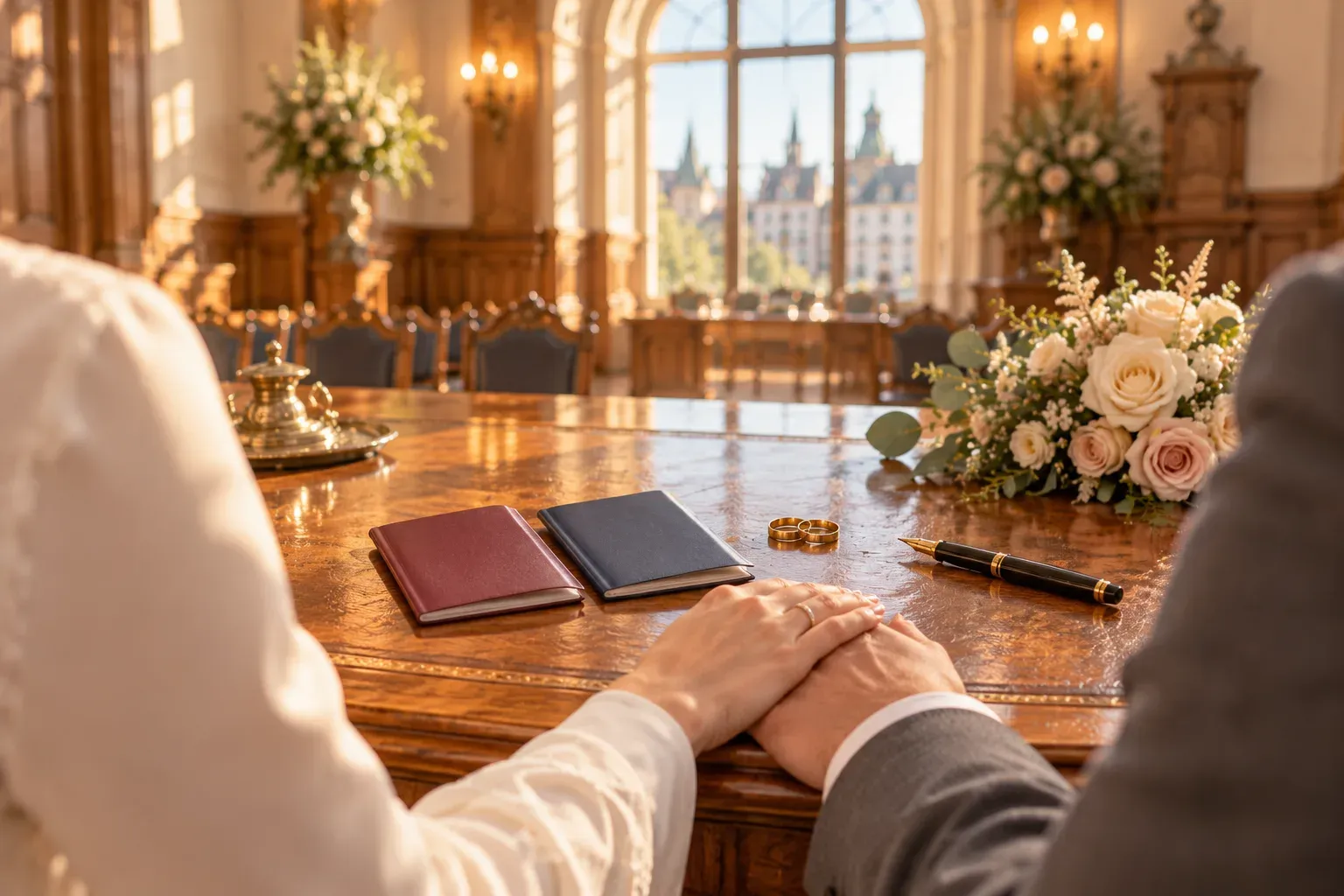
Getting Married in Germany as a Foreigner: Documents & Steps (2026)
You do not need to be German to marry in Germany — international couples tie the knot here every year, in Berlin town halls and on Bavarian lakes alike. The catch: German marriage law runs on paperwork, and a foreign passport adds more of it. This guide covers which registry office is responsible, the documents foreign nationals need, the certificate of no impediment (Ehefähigkeitszeugnis), apostilles and translations, real fees from German cities and what to do after the wedding. Requirements depend on your nationality and every office has its own procedures, so treat this as a map — the binding list is the one your Standesamt gives you.
Can foreigners get married in Germany?
Yes. Neither partner needs German citizenship, and the fixed rules are few:
- A civil ceremony at a registry office (Standesamt). A marriage is only concluded when both partners declare before the registrar that they want to marry each other (§ 1310 of the German Civil Code, BGB).
- Both of you in person, at the same time (§ 1311 BGB) — proxy marriages are not possible.
- Age 18 or over (§ 1303 BGB), and neither of you may still be married to someone else.
- Open to same-sex couples (§ 1353 BGB) — though your home country decides for itself whether it recognises the marriage.
Because at least one of you is subject to foreign law, the registry office also checks whether you are free to marry under your home country’s law. That check is what most of this guide is about.
Civil vs. symbolic ceremony: only the Standesamt counts
A church wedding or a freie Trauung (a symbolic ceremony led by a celebrant) has no legal effect on its own in Germany. Many couples therefore split the day: a short civil ceremony — Munich’s registry office says about 15 minutes — followed by a symbolic ceremony and party at a venue of their choice. Witnesses are optional; you may bring one or two (§ 1312 BGB). Where the civil ceremony can take place is set locally: Munich only marries couples in its designated ceremony rooms, while other cities offer historic town halls, palaces or even a Cologne cable-car gondola.
Step by step: from first contact to “I do”
1. Find the responsible registry office
Under § 12 of the Civil Status Act (PStG), you register your intention to marry — the Anmeldung zur Eheschließung — at the Standesamt where at least one of you lives. If neither of you lives in Germany, the registry office where you want to marry is responsible; the Federal Foreign Office tells couples abroad to contact that office first. Once registered, you can marry at any registry office in Germany within six months, usually for an extra fee.
2. Get your personal document list
With a foreign partner, most offices want to advise you first. Berlin requires a personal consultation; Cologne’s is mandatory but free; Munich issues a written initial assessment via its contact form (€25, credited against the registration fee); Hamburg uses a self-disclosure form sent by email. The result is a list tailored to your nationalities and history.
3. Collect, legalise and translate documents
Usually the slowest part — see the sections below.
4. Register the marriage (Anmeldung)
- Timing: offices such as Berlin and Cologne accept the registration no earlier than six months before the wedding.
- Validity: if more than six months pass after the office confirms the registration without you marrying, you must register again (§ 13 (4) PStG).
- How: the law allows registration orally or in writing, but offices set their own procedures. Usually you both attend with original documents; an absent partner typically needs to sign an authorisation.
5. Exemption, if needed
If your country does not issue a certificate of no impediment, the registry office forwards your file to the regional appeal court (details below).
6. Book the date and marry
Booking differs widely: Stuttgart takes reservations up to 18 months ahead online, Hamburg-Nord releases dates exactly one year ahead, several Berlin offices six months ahead. Popular Saturdays and special venues go quickly. On the day, bring valid passports for yourselves, any witnesses and your interpreter.
Documents checklist for foreign nationals
No checklist covers every nationality, but offices typically ask for the following — always as originals:
- Valid passport (EU citizens can often use their national ID card; non-EU citizens living in Germany may need their residence permit).
- Birth certificate — ideally a full version showing your parents, with apostille or legalisation where required and a German translation or multilingual form.
- Proof of residence and marital status as your case requires.
- Certificate of no impediment from your home country — or the documents needed for an exemption.
- Previously married? The marriage certificate plus the final divorce decree or your former spouse’s death certificate.
- Children together? Their birth certificates and, if applicable, acknowledgement of paternity.
EU citizens
Under EU Regulation 2016/1191, German offices cannot demand an apostille on covered public documents from another EU country — including birth, marriage, marital-status and capacity-to-marry documents. Instead of a sworn translation, you can ask the issuing authority for a multilingual standard form. Certificates of no impediment issued on the international CIEC model by a contracting state are also accepted without further formalities.
Non-EU citizens
Expect apostilles or legalisation plus sworn German translations. Offices may also want recent documents: the US Embassy in Germany tells US citizens that documents must have been issued within the last six months, so you may need a fresh birth certificate.
Divorced abroad? Check recognition first
A foreign divorce may need formal recognition before you can remarry here (§ 107 of the Family Procedure Act, FamFG). According to Berlin’s justice administration, this is not needed for divorces from EU member states (except Denmark) or from the country of which both spouses were exclusively nationals at the time. Otherwise the fee is €15 to €305; Berlin cites a typical €160.
Certificate of no impediment and the exemption
The Ehefähigkeitszeugnis confirms that nothing under your home country’s law prevents you from marrying this particular person. Under § 1309 BGB, anyone whose capacity to marry is governed by foreign law must provide one. It is valid for six months from issue, unless it states a shorter period.
If your country does not issue one
Not every country does — the US Embassy in Germany, for example, states that no such government document exists in the United States. You then need an exemption (Befreiung) from the president of the regional appeal court (Oberlandesgericht): in Berlin the Kammergericht, elsewhere for example the courts in Munich, Cologne, Frankfurt, Stuttgart or Hamburg. The court checks, in place of your home authority, whether your home law stands in the way.
- Apply through the registry office, not the court. The Standesamt prepares the application, forwards it once your file is complete and handles questions about progress.
- Fee: €15 to €305, based mainly on income (Judicial Administration Costs Act, JVKostG, No. 1330). Cologne and Stuttgart note it is charged per person needing the exemption.
- Processing time: the Kammergericht says at least three weeks; the Bavarian appeal courts about six weeks from receipt of the complete file; the Stuttgart court three to six weeks. Difficult cases take longer.
- Validity: six months (§ 1309 BGB).
The Stuttgart court stresses that a reserved date is not guaranteed until the exemption is granted — hold off on non-refundable bookings until then.
Apostille, legalisation and translations
Registry offices must be satisfied that foreign documents are genuine. How depends on the issuing country:
- Apostille: countries party to the 1961 Hague Apostille Convention in relation to Germany attach an apostille issued by a designated home authority — in the US, the Secretary of State of the issuing state.
- Legalisation: otherwise, the German embassy or consulate in the issuing country legalises the document. According to the Federal Foreign Office, this still applies to some convention members Germany objected to, including India, Morocco, Pakistan, the Philippines, Tunisia and Vietnam.
- Legalisation suspended: for more than 40 countries, German missions verify documents in other ways at a German authority’s request. Frankfurt’s registry office notes that these checks are chargeable, paid in advance and can take weeks or months.
- No formalities: covered EU documents, civil-status documents on the CIEC model and documents under certain bilateral agreements.
Sworn translations
Documents not in German must be translated by a translator sworn or officially appointed in Germany — not by yourself — and translations cannot be apostilled. The justice system’s database at justiz-dolmetscher.de lists sworn translators. Names in Arabic, Greek, Hebrew or Cyrillic script are transliterated to ISO standards; multilingual international certificates generally need no translation.
Language: when you need an interpreter
The ceremony is held in German. If one of you does not speak enough German, you must bring a sworn interpreter to the registration and the wedding — Munich and Berlin both say so, and Munich adds that the same applies to witnesses. Cologne lets friends or relatives interpret at the initial consultation. Interpreters count towards the ceremony room’s guest limit.
Visa and residence: what official sources say
Marrying in Germany and living in Germany are separate legal questions. The Federal Foreign Office says:
- Marrying a partner who lives in Germany: first ask your Standesamt which documents you need. Once it confirms they are complete, your partner can apply for a visa for the purpose of marriage. The German mission asks the local immigration office (Ausländerbehörde) and can only issue the visa once it agrees.
- Both living abroad: once the Standesamt where you want to marry has confirmed your registration, apply for any visa you need at the German mission.
- Staying afterwards: this is family reunification, a separate process. EU, EEA and Swiss citizens need no visa, and citizens of some countries — including the UK, US, Canada and Australia — can apply for their residence permit after entering. Everyone else generally applies for a spouse visa first.
Whether you need a visa just to enter depends on your nationality — check with the German mission responsible for you.
What does it cost? Real examples from German cities
Fees are set by each federal state or city, and a foreign partner almost always makes the registration pricier. From official city pages:
- Berlin: €45 registration, plus €45 for each partner whose foreign law must be checked; marriage certificate €12.
- Cologne: €40 registration, or €66 if one of you is not a German citizen.
- Munich: €60 to about €350 at the registration appointment depending on your requirements, up to €900 for the town hall or Nymphenburg Palace; the initial assessment costs €25 and is credited.
- Stuttgart: €110 registration when foreign law applies (€65 with German law only), plus a €45 state fee for a ceremony during office hours.
- Frankfurt: €47 registration plus €23.50 per foreign law applied.
- Hamburg: at least €74.50 registration, more when foreign law has to be checked.
Case-dependent extras come on top: the exemption fee (€15 to €305), apostilles or legalisation, sworn translations, an interpreter and extra certificates. There are no official figures for these, so get quotes early.
Registry fees are the smallest line in the budget. For venue, catering, photography and the rest, see How much does a wedding cost in Germany?.
Timeline: how to plan it
There is no official timeframe — it depends on your nationality, documents and city. A realistic order:
- As soon as you pick a city: contact the Standesamt, get your document list and find out how dates are released.
- Next: order certificates and apostilles, then translations. Watch expiry dates — certificates of no impediment last six months.
- Within six months of the wedding: register. If you need an exemption, add the court’s processing time.
- Only then: book non-refundable services, and confirm interpreter, witnesses and guest numbers.
After the wedding: certificates and names
Order enough copies of your marriage certificate (Eheurkunde). For use abroad, registry offices issue a multilingual international marriage certificate (€12 in Berlin). It needs no apostille in the EU and is exempt from formalities in CIEC convention states; elsewhere you may need an apostille or legalisation of the German certificate — which German authority issues apostilles varies by federal state, so ask the issuing registry office. Some countries also expect you to register a marriage performed abroad at home.
Your married name: since 1 May 2025, a person’s name is governed by the law of the country where they are habitually resident (Art. 10 EGBGB). At or after the wedding, you can choose by declaration to the Standesamt the law of a country one of you is a citizen of or lives in. Under German law you can keep your own names, take one partner’s surname or — new since 2025 — a double surname from both. Check that your home country will recognise your choice, or you may end up with different names in different passports.
The destination-wedding alternative: marry at home, celebrate in Germany
If the paperwork sounds daunting, many international couples marry legally at home and then celebrate in Germany with a symbolic ceremony at a castle, vineyard or lakeside venue — no German registration, certificate of no impediment or sworn translations, and full freedom over setting and language. According to the Federal Foreign Office, Germany generally recognises a marriage concluded abroad if both partners met their home countries’ requirements and the ceremony followed the local form. German embassies cannot perform marriages.
Prefer the Standesamt in one of Germany’s big cities? We also publish detailed German-language registry office guides for Berlin, Munich, Hamburg, Cologne, Frankfurt and Stuttgart.
Frequently Asked Questions
Can foreigners get married in Germany?
Yes. Neither partner needs German citizenship. The legal marriage has to take place as a civil ceremony at a German registry office (Standesamt), with both partners present in person, aged 18 or over and not married to anyone else. Foreign partners must usually provide a certificate of no impediment from their home country, and documents may need an apostille or legalisation and a sworn German translation. Religious or symbolic ceremonies have no legal effect on their own.
What documents do I need to get married in Germany as a foreigner?
Typically a valid passport, a birth certificate (with apostille or legalisation where required), proof of marital status and residence, and a certificate of no impediment (Ehefähigkeitszeugnis) from your home country. If you were married before, you also need the marriage certificate and final divorce decree or death certificate. Documents not in German need a translation by a translator sworn in Germany. The exact list depends on your nationality — your registry office gives you a personal list after a consultation.
What is an Ehefähigkeitszeugnis and what if my country does not issue one?
An Ehefähigkeitszeugnis, or certificate of no impediment, confirms that nothing under your home country’s law prevents you from marrying your partner. It is valid for six months. If your country does not issue one — the United States, for example — the president of the regional appeal court (in Berlin the Kammergericht) can grant an exemption. You apply through the registry office, not the court. The fee is €15 to €305 depending on income, and processing takes several weeks.
Do I need an apostille on my birth certificate to marry in Germany?
It depends on the issuing country. Documents from countries in the Hague Apostille Convention usually need an apostille; documents from other countries need legalisation by the German embassy, and for some countries German missions verify documents in a separate procedure. Public documents from other EU countries do not need an apostille under EU Regulation 2016/1191, and a multilingual standard form can replace the translation. Your registry office tells you what applies to you.
Can we get married in Germany if neither of us lives there?
Yes. If neither of you has a residence in Germany, the registry office in the town where you want to marry is responsible for the registration. Contact it early to get your document list. Once it has confirmed your registration, you can apply at the German embassy or consulate for any visa you need to enter. Many offices expect you to attend in person with original documents, so ask how registration works for couples living abroad.
Can we have a civil wedding in Germany in English?
The legally binding civil ceremony is held in German. If one of you does not speak enough German, you must bring a sworn interpreter to the registration and the ceremony; some cities, such as Munich, require the same for witnesses who do not speak German. If you want a ceremony fully in English, a common solution is a short civil ceremony with an interpreter followed by a symbolic English-language ceremony at your venue.
How much does it cost for a foreigner to get married in Germany?
Registry office fees vary by city. Examples: Berlin charges €45 for the registration plus €45 per partner whose foreign law must be checked; Cologne €66 if one partner is not German; Stuttgart €110 when foreign law applies; Munich between €60 and about €350 at registration. Add the court’s exemption fee if needed (€15 to €305), marriage certificates, and the costs of apostilles, sworn translations and an interpreter, which depend on your country and documents.